The City’s new housing plan, Block by Block, strongly supports community ownership. Indeed, the Deputy Mayr said, “All of the strategies and every aspect our work focus on community ownership.” Given the high development costs of creating new housing, especially homeownership opportunities, community land trusts create a way to sustain the impacts of public investments over generations. The city’s housing plan, therefore, offers new tools: new capital funding, programming, legislative priorities, code enforcement, and other strategies.
According to a new report by HR&A, entitled, We Can Own New York City’s Future: Lessons from Change Capital Fund’s Community Ownership Grantees, “What makes this an urgent moment is the wave of distressed, over-leveraged rent-stabilized buildings that will change hands in the next five years.” Cea Weaver, Director of the Mayor’s Office to Protect Tenants, estimated that there are tens of thousands of apartments in these portfolios. These troubled properties are a problem to be solved; they also add to a potential pipeline to increase stable, permanently affordable, community governed housing. Violation-ridden portfolios of rent stabilized buildings are a focus for the new administration.
Over the past decade, the New Economy Project and members of the New York City Community Land Initiative have been organizing and planning to increase community ownership in New York City. Believing that ownership is the power needed to combat displacement, communities have been inventorying property in their neighborhoods and conducting community-engaged planning to turn these properties into community assets in perpetuity. The properties include these over-leveraged, neglected properties. They include vacant lots and parking lots, city-owned property and private, housing and unused manufacturing sites. With strong support in City Council and NYCCLI’s advocacy, it is likely that the Community Opportunity to Purchase Act, passed by City Council in December 2025 but vetoed by the outgoing Mayor, will be passed again in fall 2026, this time with the support of Mayor Mamdani. This legislation, which gives tenants the right to purchase their building, creates another potential pipeline of properties for community ownership.
At the start of our cycle, few CCF grantees owned property. Most were nascent organizations, starting with one or, even, no staff. CCF provided core support to enable the groups to hire project management staff, TA funding for critical predevelopment costs, and direct access to legal and programmatic help. CCF’s 4-year funding may have given city agencies added confidence to award properties to our grantees.
Following years of organizing, CCF’s eight grantee organizations are turning their communities’ dreams into bricks-and-mortar projects. These include community land trusts (CLTs) such as East Harlem-El Barrio CLT, East NY CLT, Interboro CLT, Real Edgemere CLT, and Our Bronx (Bronx CLT). These organizations are developing 17 buildings that will generate over 562 units of permanently affordable housing, most homeownership, that will remain affordable because of the deed restrictions in the community land trusts (CLTs). In CLTs, the property is owned by the resident or a nonprofit but the land remains the property of the CLT. The building pays ground lease fees to the land trust, which stewards the properties, making them affordable for generations. In addition, grantees are developing five notable community facilities and economic hubs, including the iconic Kingsbridge Armory (Our Bronx), the historic Lincoln Recovery Center (South Bronx Unite), an unused space under the Bruckner Expressway (Youth Ministries for Peace & Justice), the Central Brooklyn Food Coop and food hub in a Riseboro affordable housing project, and a new community center in a vacant manufacturing building (East NY CLT).
In order to build on the momentum of this cohort of grantees, CCF seeks to help implement the recommendations of HR&A’s report, including, helping to raise the needed capital that community ownership requires. At the forum, we heard from Emily Duma, who is leading an effort in California at the Common Counsel to establish the Community Ownership for Community Power Fund. We also heard from Kristin Giantris, Nonprofit Finance Fund and Christine Hollenback, Justice Capital who offered inspiration for organizing capital to create increased shared equity.
Finally, our day ended with a panel about how to expand community ownership with hints at a deal being crafted in East Harlem. Five buildings have organized and elected to be part of the East Harlem-El Barrio Community Land Trust and funders, investors, a developer, the Mayor’s office and the New Economy Project’s Loan Fund for Community Ownership are some of the partners trying to demonstrate that current market conditions can be an opportunity to move troubled housing into well-structured, healthy, safe social housing in perpetuity.
Starting in January 2027, CCF will launch a second four-year cycle to support the operations of community ownership organizations. In addition, CCF sees a role for the collaborative of banks and foundations to help cultivate the ecosystem for CLTs to thrive. This will include technical assistance to establish sustainable business models. Some of our funders have been part of early conversations about raising a capital acquisition fund, a recommendation in HR&A’s report.
The convergence of strong city support, increasing community capacity, market forces and philanthropic support creates a rare moment of opportunity to increase the composition of community-owned and social housing in New York City. To seize the moment, capital is needed. We must leverage both private and philanthropic capital, increase collaboration between the City and philanthropy and continue to support the operations of community land trusts. It is a dire moment; with all these sectors working in the same direction, we can make it a historic moment, one that changes the composition of ownership in New York City.
Watch the full presentation here.


 ]]>
]]>Features eight organizations advancing 18 projects across the five boroughs, creating over 800 permanently affordable housing units and community-controlled assets
NEW YORK, NY (June 22, 2026) — In East New York, tenants of a neglected apartment building voted to purchase their property and convert it into a permanently affordable cooperative. Their effort is one of 18 community ownership projects highlighted in a new report from the Change Capital Fund (CCF), a collaborative of New York City’s leading banks, foundations, intermediaries and the NYC Mayor’s Office for Economic Opportunity. We Can Own New York City’s Future: Lessons from Change Capital Fund’s Community Ownership Grantees is a report from CCF and prepared by HR&A Advisors that looks at how local residents are organizing to form community land trusts, and other forms of community ownership that give residents control of residential buildings, development sites, and major community assets that will remain permanently affordable and community-governed.
We Can Own New York City’s Future examines eight organizations across the five boroughs that received almost $10 million total over four years for operational and technical grants from CCF starting in 2023. These organizations, many newly formed, are advancing community ownership models such as community land trusts and limited-equity cooperatives, worker and consumer coops, and partnerships with government on City land. By removing housing from the speculative market, these models help combat displacement and strengthen neighborhood stability.
“Every New Yorker deserves a safe, affordable home, and as we lay out in the Block by Block housing plan, we are committed to protecting tenants’ rights, helping stabilize at-risk buildings, and exploring new models of community ownership. In this critical moment for housing in New York City, we appreciate this report’s recommendations, and we look forward to working with all stakeholders to expand access to affordable, quality housing for generations to come,” said Housing Preservation and Development Commissioner Dina Levy.
These efforts are leading 18 community ownership projects that will produce 823 units of permanently affordable housing: 697 units for homeownership and 126 units for rent. Of those, 245 are already occupied by tenants. This creates opportunities for hundreds of New Yorkers, including:
Housing
- In East New York, tenants are converting a poorly maintained rental building into a permanently affordable cooperative as part of The East New York Community Land Trust.
- In East Harlem, residents have moved or are readying to move into four buildings that will be in the East Harlem El Barrio Community Land Trust.
- In Queens, first-time homeowners are moving into newly constructed passive houses through the Interboro Community Land Trust, trading property appreciation for affordability, limited equity, and multi-generational security.
- In the Rockaways, residents are planning a 119-lot development as part of the ReAL Edgemere Community Land Trust.
Community Assets
- After 15 years of community organizing in Mott Haven, South Bronx Unite gained control of the Lincoln Recovery Center and raised the $45 million needed to transform the historic site into a center for community health and culture.
- The Kingsbridge Armory – the largest armory in the country, which was vacant for over 30 years – will be partially owned by the community and transformed into an economic and cultural hub by Our Bronx.
Economic Development
- Youth Ministries for Peace and Justice won a contract to activate unused land under the Bruckner Expressway as an economic engine that features concessions, art, and a flea market.
- The Central Brooklyn Food Coop is joining forces with worker-owned food businesses supported by RiseBoro Community Partnership to create an oasis of healthy food in an affordable housing development.
The report documents these achievements and makes recommendations to expand community-controlled housing and real estate as tools to preserve affordability and limit displacement. Community ownership was included in Mayor Zohran Mamdani’s housing plan, Block by Block, as one way to help address housing affordability and displacement, which has emerged as a growing strategy in New York City’s housing policy discussions.
“Change Capital Fund is excited to share the impressive accomplishments of the eight grantees we have supported over the last three and a half years. They are turning their communities’ dreams and visions into bricks and mortar, expanding opportunities that provide a secure future for people now living in New York City’s low-income communities,” said Chantella Mitchell, Co-Chair, Change Capital Fund, Program Director, New York Community Trust.
The report features recommendations to other funders and City and State policymakers about how best to support the community ownership ecosystem at this moment of unusual urgency and opportunity, including:
- Increase operating support: Expand government and philanthropic operating support for community organizations as community ownership moves toward sustainable scale.
- Open the public land pipeline: City government should open the public land and disposition pipeline for community ownership.
- Provide fast, flexible capital: Deploy capital that moves at the speed of the private market to realize the potential of policies such as the Community Opportunity to Purchase Act (COPA) and opportunities to convert affordable housing into permanently affordable social housing.
- Build field infrastructure: Philanthropy, the field, and city government should build the shared stewardship and field infrastructure that community ownership depends on.
“We literally didn’t have the security of a locked door to our building. Now we are making our home what we want it to be – safe, clean, well-run, and maintained. The tenants of our building look forward to being owners – owners in cooperation,” said Ana Markland, President, 248 Arlington Avenue Tenants Council.
“Our Bronx is proud to be a vehicle for moving the aspirations of Bronx residents into reality. Community ownership is not a fringe idea; it is a proven, financially sound strategy to preserve affordability, prevent displacement, and ensure that the wealth created in our neighborhoods benefits the people who have invested in them for generations,” said Sandra Lobo, Executive Director, Our Bronx.
We Can Own New York City’s Future was announced at the Housing Affordability and Community Ownership Forum, where representatives from city government, philanthropy, finance, affordable housing, and community organizations convened to discuss ways to increase the share of community-controlled housing in New York City.
The next CCF grant cycle will begin in 2027 to sustain the community ownership movement’s momentum.
# # #
About Change Capital Fund
Change Capital Fund (CCF) is a 22-member donor collaborative consisting of corporate philanthropy, foundations, intermediaries, and the Mayor’s Office for Economic Opportunity. In 2023, CCF launched a four-year funding cycle to support eight community ownership organizations in New York City as they built their capacity to engage in the active development of community-controlled real estate.
Current CCF members include: Altman Foundation, Amalgamated Bank, Bank United, Capital One, Deutsche Bank Americas Foundation, Enterprise Community Partners, Goldman Sachs, HSBC Bank, JP Morgan Chase, Local Initiatives Support Corporation, M&T Charitable Foundation, MUFG, New York Foundation, Principal Foundation, Santander Bank, Scherman Foundation, The New York Community Trust, Trinity Church Wall Street, United Way of New York City, U.S. Bank, Wells Fargo Bank, and the Mayor’s Office for Economic Opportunity (ex officio).
About HR&A Advisors
HR&A Advisors, Inc. (HR&A), an employee-owned company, helps cities tackle their most pressing challenges. For over 50 years, HR&A has guided public, private, and nonprofit leaders through high-stakes decisions that create impact. We combine rigorous analysis with creative problem-solving to unlock investment, expand opportunity, and bring communities to life. Learn more at hraadvisors.com.
The submissions tackle issues at the heart of the community development agenda, Change Capital Fund’s primary focus. The strategies would support safe, healthy, and affordable housing; economic opportunity through job training and creation while integrating features to enhance the livability of neighborhoods, from a public health, quality of life, and infrastructural resilience perspective. If implemented, the proposals, summarized in the report, would transform highly polluted, unused public spaces into accessible green space, create parks that both protect residents against flooding and mitigate toxic discharge into NYC’s waterways, create safe and healthy housing in basement apartments, make e-bikes safer and more available to delivery workers. Proposed projects would create hundreds of jobs in composting, energy efficiency improvements, and community solar installations.
The proposals “represent solutions to our city’s needs,” says Elijah Hutchinson, Executive Director of the Mayor’s Office of Climate & Environmental Justice, which assisted many organizations and city agencies to apply to the federal government.
When one of Change Capital Fund’s grantees leveraged a modest grant into a federal award of $4 million, several of the collaborative’s members were inspired to raise a fund to enable NYC organizations to apply for federal grants. Ten grantees submitted ten proposals with the collaborative’s help, one-third of the 30 proposals submitted from New York City. The proposals were labor intensive to prepare, requiring strategies that could be implemented within three years, partnerships codified in written agreements, detailed plans, timelines and budgets. When Change Capital Fund reviewed all the proposals submitted from New York City, its funders found a treasure trove of forward-looking, actionable ideas. Their report is meant to lift up these ideas.
“We hope our report inspires continuing conversation and, ultimately, implementation of these ideas to help improve the health, economic prospects, and quality of life of New York City’s neighborhoods,” said Mike Pratt, President of Scherman Foundation and Change Capital Fund Co-Chair.
“At United Way of New York City, we believe bold solutions are born when those closest to the challenges are empowered to lead, asserts Grace Bonilla, Esq., President & CEO, United Way of New York City, “The ideas surfaced through this report reflect the ingenuity and urgency of our neighborhoods.”
###
Change Capital Fund (CCF) is a collaborative of NYC’s leading foundations, financial institutions, the United Way of New York City, intermediaries and the Mayor’s Office for Economic Opportunity. It works to increase economic opportunities in NYC’s low-income neighborhoods by strengthening community-based development organizations.
Change Capital Fund members include: Altman Foundation; Amalgamated Bank, BankUnited, Capital One, Deutsche Bank Americas Foundation, Enterprise Community Partners, Goldman Sachs, HBSC, JPMorgan Chase, LISC NYC, The M&T Charitable Foundation, Mayor’s Office for Economic Opportunity, ex-officio, New York Foundation, Principal Foundation, Santander Bank, Scherman Foundation, The New York Community Trust, Trinity Church Wall Street, U.S. Bank Foundation, United Way of New York City, Wells Fargo.
]]>Change Capital Fund, a 21-member collaborative of banks, foundations and intermediaries, is awarding 10 NYC environmental justice organizations grants to help them benefit from a flood of new federal resources to realize their community’s visions for healthy, sustainability and resiliency.
The Inflation Reduction Act, unarguably the largest source of funding for climate and environmental justice solutions in U.S. history, is offering in the range of $45 billion to disadvantaged communities overburdened by pollution. The catch is, that many environmental Justice organizations in New York City don’t have a lot of capacity to undertake the complicated funding applications required by federal agencies.
CCF’s EJ Fund will distribute $500,000 in grants to the following 10 NYC-based environmental justice organizations to enable them to hire fundraisers, coalition coordinators and the like to support their ability to qualify for the new flood of federal funds. Change Capital Fund believes that the fund has the potential to bring millions of dollars into neighborhoods that have long suffered from toxic infrastructure to help realize projects that may have been planned for years, even decades.
Should our grantees access the federal funds they aspire to, they would:
Implement long-held community plans for increased health, sustainability, resiliency
- THE POINT Community Development Corporation, South Bronx will create a community-shared solar project and electric shuttle service providing Hunts Point residents access to waterfront parks
- UPROSE, Sunset Park, Brooklyn will advance key priorities of their community’s community plan to create a Just Transition Worker Resource Center, special zoning district, pre-apprenticeship training; and to decarbonize and install rooftop solar on senior citizen centers of Sunset Park.
- NY Renews will engage with organizations statewide to garner state and city commitments to draw down of IRA/EJ funding for environmental justice projects.
Restore and retain open space:
- Bronx River Alliance, Inc./ RAIN Coalition, South Bronx will plant 2500 trees and install and maintain green infrastructure to maintain open space.
- Real Edgemere CLT, Far Rockaway, Queens will create and implement a resilient open space plan in an area prone to flooding.
Retrofit existing buildings to be more energy efficient and resilient:
- Pratt Institute Center for Community Development will partner with community organizations in Brooklyn and Queens to retrofit 300 homes owned by low- and moderate- income homeowners. Federal funds would subsidize a package of electrification-readiness measures, including gas to induction stove change-outs, electrification, health & safety repairs such as mold remediation and gas leaks that must be fixed before making the buildings more airtight.
- Northwest Bronx Community & Clergy Coalition, Bronx will increase weatherization efforts to integrate LEED standards in Bronx projects, training residents for retrofit jobs.
- Chhaya Community Development Corporation, Queens will partner with the City’s Housing Department to implement a basement conversion program for low- and moderate-income homeowners.
Engage in transportation planning:
- El Puente de Williamsburg, Inc, Brooklyn will engage community members and partner with the NYC Department of Transportation to ensure that plans to update the BQE reflect community priorities for health and justice.
Train young people in the new green economy:
- Green City Force will expand their direct service programs to prepare 800 young people for green jobs; open 4 new eco-hubs (community farms) powered by a civilian climate corps, provide food to 10 frontline communities/year.
CCF introduced all applicants to the Fund to organizations that can help them apply for federal funding. The Environmental Protection Network, a network of some 600 former EPA career staff and political appointees from across the country provides pro bono consulting; WeACT TCTAC, which was awarded $10 million by the Environmental Protection Agency, provides assistance to groups in EPA Region 2; and, the Mayor’s Office for Environmental and Climate Justice is partnering with nonprofits to apply for federal funds.
Because of The federal administration’s Environmental Justice 40 Initiative (EJ40), 40 percent of the benefits of federal environmental investments are being directed to disadvantaged communities. The EJ40 language originates in New York State’s own Climate Leadership and Community Protection Act, advocated for by the New York Renews Coalition.
Altman Foundation, BankUnited, Deutsche Bank, M&T Bank, Principal, Scherman Foundation provided the funding for this initiative.
CCF also contributed to the Fund. It’s members include: The Altman Foundation, BankUnited, Capital One, Deutsche Bank, Enterprise, Goldman Sachs, HSBC, JPMorgan Chase, LISC, M&T Bank, MUFG, New York Foundation, The New York Community Trust, Principal, Santander Bank, Scherman Foundation, Trinity Wall Street, United Way of NYC, U.S. Bank and Wells Fargo Bank. The NYC Mayor’s Office for Economic Opportunity is an ex-officio member.
###
]]>At a recent panel, hosted by the Change Capital Fund, City officials supported the calls of Change Capital Fund’s grantees for new policies, increased investment and urgency in deploying land and buildings for community purpose, including affordable housing, community centers, and commercial spaces for neighborhood enterprises. The panel was moderated by Alyssa Katz, Executive Editor of The City and included: NYC Comptroller, Brad Lander; NYC Chief Engagement Officer, Betsy MacLean; Mychal Johnson, Co-Founder of South Bronx Unite; and Sandra Lobo, Executive Director of Northwest Bronx Community and Clergy Coalition.
“We aren’t going to be able to build a more equal and a more inclusive economy where folks have stability in their housing, in their lives and in their families and some measure of autonomy with their neighbors if we don’t take the democratization of wealth and control seriously,” affirmed NYC Comptroller, Brad Lander.
“Top-down planning has not really helped the people who are in our communities that are suffering from displacement, health issues, economic and social injustices; so, we see planning from the ground up as necessary. We have to be the ones to develop our own path forward,” asserted Mychal Johnson, a founding member of South Bronx Unite. South Bronx Unite is seeking to redevelop the Lincoln Recovery Center, a City-owned property, which has been vacant and deteriorating for 11 years, as a cultural, educational and health center. The organization has engaged hundreds of community members in planning the new community center.
“Our people are getting displaced. Our communities are getting gentrified and, at the end of the day, we don’t own anything,” said Sandra Lobo, Executive Director of the Northwest Bronx Community and Clergy Coalition. The coalition has formed a Bronx Community Land Trust and are planning the development of several properties as permanently affordable housing. “If you look in the Bronx right now, most residents live in multi-family, rent stabilized houses. It’s not a realistic objective for them to ever own their own home unless it’s through passing the Tenant Opportunity to Purchase Act (TOPA) and they own it collectively with Community Land Trusts as partners, ensuring affordability over the long haul,” said Lobo.
“You can look at community ownership in two ways,” said Betsy Maclean, NYC Chief Engagement Officer. “It’s a way to build equity, a way to build power… You can also think of it as a home. And to me, home is everything. Home is belonging. Home is connection to your neighbors. Home is well-being. Home is love.”
Lander proposed that the City work to double the number of permanently affordable housing units and estimates that would get us to only 20% of all city housing stock. “That would take public policy, support on the ground and a lot of capacity building,” he said.
Change Capital Fund is investing in eight organizations and collaborations, out of more than 30 applications received from NYC-based organizations. The grantees are mostly small organizations, led by people of color, who are seeking to create new, permanently and deeply affordable rental housing or home-ownership opportunities, open spaces, community facilities, cooperatively-owned food businesses and/or food hubs. The intention is that the properties will be held as community land trusts or other forms of permanent community ownership.
Panelists:
- Alyssa Katz (moderator) is executive editor with The City (TheCity.nyc) and a former member of the NY Daily News editorial board. Previously, she was editor of The New York World and City Limits. She has served on the Local Advisory Committee for LISCNYC and as a communications consultant with the Pratt Center for Community Development. Katz is the author of the books “Our Lot: How Real Estate Came to Own Us” and “The Influence Machine: The U.S. Chamber of Commerce and the Corporate Capture of American Life.”
- Mychal Johnson is a founding advisory board member of South Bronx Unite. As a long-time activist and advocate for environmental, economic and social justice in the South Bronx, he is a founding member and board member of the Mott Haven-Port Morris Community Land Stewards. Mychal serves on the board of directors of the NYC Community Land Initiative (NYCCLI), the Bronx Council for Environmental Quality, and the Community Advisory Board of Columbia University’s NIEHS Center for Environmental Health in Northern Manhattan. Mychal was also appointed as a civil society voting member of the New York State Department of Environmental Conservation Open Space Committee. He has been a member of Bronx Community Board 1 and was notably selected by the United Nations to serve as one of 38 global civil society appointees to the historic UN Climate Summit in 2014.
- New York City Comptroller Brad Lander was elected to serve as our city’s budget watchdog and chief accountability officer in 2021. In City Council, Lander co-founded the Progressive Caucus. He spearheaded efforts to protect workers and build a more equitable economy. He helped lead a successful grassroots effort to desegregate the middle-schools of Community School District 15, partneredwith advocates and legislators to combat discriminatory stop-and-frisk policing and helped bring participatory budgeting to NYC. Lander was one of the founders of Local Progress, now a 1000-member strong network of local elected officials advancing a racial and economic justice agenda through all levels of local government. Prior to holding public office, Lander spent 15 years in the nonprofit sector as the director of the Fifth Avenue Committee and the Pratt Center for Community Development
- Sandra Lobo is the Executive Director of the Northwest Bronx Community & Clergy Coalition (NWBCCC), a 49-year-old member-led organization that unites diverse people and institutions to fight for racial and economic justice through intergenerational organizing. The NWBCCC organizes around health justice, environmental sustainability, school to prison pipeline, equitable economic and community development, and safe affordable housing. Before this role, Sandra was trained in anti-oppression organizing and leadership development incorporating a restorative justice framework. She served as Director of the Dorothy Day Center for Service and Justice at Fordham University for 17 years, shifting the focus of the Center’s work from a charity to a justice model. Sandra has served as a board member of the Simon Bolivar Foundation and Robert Sterling Foundation Advisory Council. She currently serves as President of the Bronx Community Land Trust.
- Betsy MacLean is New York City’s first-ever Chief Engagement Officer for NYC. Appointed in 2022, she ensures that community engagement is a core function of NYC government to advance democracy, justice and belonging. In addition, Betsy led the Civic Engagement committee of NYC Mayor Eric Adams’ transition team and the Housing, Land Use & Planning committee of Brooklyn Borough President Antonio Reynoso. Before City Hall, Betsy served as Executive Director of Hester Street, a national leader in participatory planning, policymaking, and design. Prior to moving into national work, Betsy was the Director of Community Development at Cypress Hills LDC in East New York, Brooklyn. There she planned and developed hundreds of affordable homes, spearheaded the community-led design and construction of Brooklyn’s first green public school, and created a neighborhood-wide planning and sustainability initiative. Betsy began her career as a carpenter. Her carpentry work brought her to Cuba where she created and led an international community development program.
Change Capital Fund’s grantees:
- East Harlem/El Barrio CLT is completing rehabilitation of distressed city-owned properties as tenant-run, permanently affordable housing with land to be owned by the community land trust.
- The East New York CLT has taken stock of every vacant parcel in East New York, Brooklyn and has identified several potential development sites for permanently affordable housing. They also seek to establish a preservation pilot program to model alternatives for tax-distressed homeowners to help them avert foreclosure.
- Interboro Community Land Trust, a collaboration between the Center for New York City Neighborhoods, Habitat for Humanity New York City and Westchester County, the Mutual Housing Association of New York, and the Urban Homesteading Assistance Board is a citywide CLT. With over 400 apartments in their pipeline, they will dramatically increase the stock of permanently affordable homeownership and wealth-building opportunities available to low- and moderate-income and BIPOC households.
- Northwest Bronx Community and Clergy Coalition is advancing three affordable housing projects on land to be put into the Bronx Community Land Trust.
- ReAL Edgemere CLT is a new organization that was awarded 62 vacant lots to create affordable, two-family homes, open space and commercial space on the Rockaway Peninsula, an area that had been devastated by Hurricane Sandy.
- RiseBoro Community Partnership and the Central Brooklyn Movement Center are collaborating to open the Central Brooklyn Food Coop as a Black-led, consumer- owned food store which will do business with several Black-owned food-based worker coops to foster an integrated, neighborhood-centered local food economy.
- South Bronx Unite seeks to renovate and repurpose the city-owned and abandoned Lincoln Recovery Center as a new H.ealth, E.ducation, and Arts hub for neighborhood connection and activities, a culinary arts kitchen, performance and co-working space as well as affordable space for local nonprofit organizations.
- Youth Ministries for Peace and Justice (YMPJ) will develop empty space under the Bruckner Expressway, Bronx as the Soundview Economic Hub to create a vibrant community space hosting food and cultural programming, clean soil distribution, employment, job training opportunities through incubator space, and intergenerational programs and activities for residents.
Wendy Fleischer, CCF Donor Representative: wendy@wendyfleischer.com; 347-683-0538
Change Capital Fund, a 20-member collaborative of banks, foundations and intermediaries, recently selected a new round of grantees which are advancing projects to repurpose un- or under-used public land or buildings as community assets. The eight projects, led by communities of color, will create new, permanently and deeply affordable rental housing or home-ownership opportunities, open spaces, community facilities, cooperatively-owned food businesses and/or food hubs. The projects will be controlled by community members.
These developing projects are manifesting the vision of a growing movement for community ownership which has been gathering momentum in New York City and across the country. The movement is animated by the belief that ownership is a source of power and a way to reshape communities that have been severely impacted by racism, under-investment and, more recently, gentrification.
Change Capital Fund will strengthen the community organizations leading these efforts through grants, capacity building and funds for project-specific technical assistance consultants. Contributing institutions include: Altman Foundation, BankUnited, Capital One, Deutsche Bank, Enterprise Communities, Goldman Sachs, HSBC Bank USA, JPMorgan Chase, LISC, M & T Bank, MUFG, New York Foundation, The New York Community Trust, Principal Foundation, Santander Bank, Scherman Foundation, Trinity Wall Street, United Way of NYC and Wells Fargo Bank.
Lisa Talma, Deutsche Bank believes, “CCF grants will provide critical resources at this time when, after years of organizing, these organizations are successfully gaining control of public land and transforming it for public purpose in line with community needs.”
Over the next four years, Change Capital Fund members will distribute approximately $8 million to eight grantees selected through a request for proposals process. Grantees will receive $150,000 per year for four years. They also will have access to a technical assistance fund to support specific project costs and will benefit from peer learning during the four-year grant cycle.
Grantee, David Shuffler, Youth Ministries for Peace and Justice says, “YMPJ is poised to transform the underside of the Bruckner Expressway into a vibrant community hub while addressing the longstanding community need for food access, economic development, and intergenerational programming. This four-year grant will go a long way to making that happen.”
Rickke Mananzala, New York Foundation, says, ““the next four years will be pivotal as these groups see the fruits of their organizing for racial and economic justice lead to vital assets owned by and for community members.”
Yajaira Lopez, Tri-State Region President, Santander Bank says: “Santander is thrilled to be part of this public/private partnership to support communities in shaping their future.”
Change Capital Fund’s grantees are:
- East Harlem/El Barrio CLT is completing rehabilitation of distressed city-owned properties as tenant-run, permanently affordable housing with land to be owned by the community land trust.
- The East New York CLT has taken stock of every vacant parcel in East New York, Brooklyn and has identified several potential development sites for permanently affordable housing. They also seek to establish a preservation pilot program to model alternatives for tax-distressed homeowners to help them avert foreclosure.
- Interboro Community Land Trust, a collaboration between the Center for New York City Neighborhoods, Habitat for Humanity New York City and Westchester County, the Mutual Housing Association of New York, and the Urban Homesteading Assistance Board is a citywide CLT. With over 400 apartments in their pipeline, they will dramatically increase the stock of permanently affordable homeownership and wealth-building opportunities available to low- and moderate-income and BIPOC households.
- Northwest Bronx Community and Clergy Coalition is advancing three affordable housing projects on land to be put into the Bronx Community Land Trust.
- ReAL Edgemere CLT is a new organization that was awarded 62 vacant lots to create affordable, two-family homes, open space and commercial space on the Rockaway Peninsula, an area that had been devastated by Hurricane Sandy.
- RiseBoro Community Partnership and the Central Brooklyn Movement Center are collaborating to open the Central Brooklyn Food Coop as a Black-led, consumer- owned food store which will do business with several Black-owned food-based worker coops to foster an integrated, neighborhood-centered local food economy.
- South Bronx Unite seeks to renovate and repurpose the city-owned and abandoned Lincoln Recovery Center as a new H.ealth, E.ducation, and Arts hub for neighborhood connection and activities, a culinary arts kitchen, performance and co-working space as well as affordable space for local nonprofit organizations.
- Youth Ministries for Peace and Justice (YMPJ) will develop empty space under the Bruckner Expressway, Bronx as the Soundview Economic Hub to create a vibrant community space hosting food and cultural programming, clean soil distribution, employment, job training opportunities through incubator space, and intergenerational programs and activities for residents.
###
]]>
Over the next four years, Change Capital Fund members will distribute $8 million to advance affordable housing, community facilities and economic development projects that are owned and designed by community-based nonprofits. CCF issued a Request for Proposals on June 30 (proposals are due 9/14/22), and will select six to ten organizations by the end of 2022. Selected organizations will receive $150,000 per year for four years. To get special help from partners and consultants with appropriate expertise, they also will have access to additional money via a designated technical assistance fund. CCF will prioritize funding for community organizations that are BIPOC-led and serve communities that have been impacted by racial and economic inequities.
Contributing institutions will include: Altman Foundation, BankUnited, Capital One, Deutsche Bank, Enterprise Communities, Goldman Sachs, HSBC Bank USA, JPMorgan Chase, LISC, M & T Bank, MUFG, Mizuho, New York Foundation, The New York Community Trust, NYC Opportunity, Principal, Santander Bank, Scherman Foundation, Trinity Wall Street, United Way of NYC and Wells Fargo Bank.
Patricia Swann, New York Community Trust Program Director and a Co-Chair of the Committee, says: “Dozens of groups in New York City are organizing community members to gain control of some of the last remaining development sites in their neighborhoods. CCF’s funding will help them do just that.”
Marc Jahr, a veteran reinvestment banking official and former head of the City’s Housing Development Corporation, will chair a specially created subcommittee to help grantees access financing and development expertise. He says: “This public/private partnership has the potential to be a game changer for community-based organizations looking to shape their communities’ future.”
It’s anticipated that the projects supported through this fund will include housing and commercial community land trusts, limited equity coops, worker coops, community investment trusts, community-owned solar initiatives, and other forms of community ownership.
Change Capital Fund is well-positioned to give a meaningful lift to the growing movement for community control of land. Its innovative capacity building feature and four-year funding cycle create the right framework for these aspiring efforts. And it builds on Change Capital’s previous investments, since a number of the organizations working to create land trusts and other vehicles for collective ownership have received CCF grants in current or past funding cycles.
Carson Hicks of the Mayor’s Office for Economic Opportunity said, “NYC Opportunity is delighted to continue our work with the Change Capital Fund. The new focus on community ownership dovetails with our efforts to promote community-driven solutions to reduce poverty.”
For more information, please visit: www.changecapitalfund.org
###
]]>Read the Essential Yet Invisible report online
Download the Essential Yet Invisible report
This report is from the Change Capital Fund (CCF). We are funders who have pooled our resources to support neighborhood-based, community development corporations for twenty-five years. Our long-term relationship with our grantees affords us an opportunity to get to know them well and we are grateful for their dedication, adaptability, and resilience. Born in crises, New York City’s community development corporations (CDCs) formed to rebuild homes and revitalize their neighborhoods, renovating over 100,000 apartments as affordable housing and putting thousands of buildings back on the tax rolls. Today, they remain essential emergency responders that work directly with residents to soften the blows of crises, call attention to the experiences of low-income people, and advocate for public policies that support them. Our grantees were behind successful organizing campaigns that are preventing hundreds of thousands of evictions and that will provide relief for undocumented workers.
]]>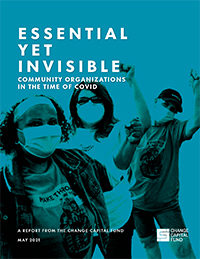 A report issued by Change Capital Fund, a collaborative of 15 funders, demonstrates the life-saving contributions of community-based organizations during the intersecting crises of the past year.
The report, Essential But Invisible: Community Organizations in the Time of Covid, details the essential services provided by community development corporations amidst public health, racial and economic justice crises.
“Community-based organizations are as essential to their communities as firehouses,” states Steven Flax, Administrative Vice President of M&T Bank and Co-Chairman of the Fund. CCF’s grantees provided $11.5 million of emergency services to more than 125,000 people in the first six months of the pandemic. The majority of those receiving services have incomes below the poverty level. The emergency services included counseling, food delivery, distribution of masks and other personal protective equipment, even financial support for burials.
This unusual and long-standing collaborative of financial institutions, community development intermediaries, foundations, United Way of NYC and the NYC Mayor’s Office for Economic Opportunity pool funding to increase the resiliency, reach and efficacy the city’s community development corporations. Change Capital Fund’s grantees provide a combination of affordable housing and housing services, social services, workforce development and community organizing in high-poverty, neighborhoods populated mostly by people of color.
Patricia Swann, Senior Program Officer at The New York Community Trust and CCF Co-Chair, says, “Like all of us, the staff of these community organizations worried about their exposure to COVID, about their out-of-school children, about elderly parents and other family members who were vulnerable to the virus due to pre-existing conditions. But they put those worries aside and devoted their energies to taking care of their communities. They delivered food and needed supplies, they consoled and comforted grieving family members, and they also organized to demand that government systematically address the needs of those most hurt by Covid.”
Change Capital Fund urges other funders to join them in supporting these organizations that are needed in good times as well as in the inevitable next crisis. They need flexible, multi-year funding, such that Change Capital Fund provides, as well as support for advocacy and organizing, minimal reporting requirements and maximum investment in internal evaluation.
###
]]>