GOLES is one of hundreds of community organizations that were born in crisis during the 1980s and 1990s, including dozens of community development corporations (CDCs) that collectively rehabilitated over 100,000 apartments that had been abandoned or foreclosed. Working in low-income neighborhoods and in pockets of poverty in gentrified neighborhoods, these organizations have quickly pivoted to operating remotely while simultaneously reaching out to people who are most vulnerable, both to the virus and to its economic impact.
Even while home schooling young children, worrying for their aging parents and afraid they will not receive their own paychecks, the staff of these organizations are taking care of thousands of our low-income neighbors, mostly people of color, who are hit first and worst by each crisis, and who struggle even in between crises. The staff at Bedford Stuyvesant Restoration Corporation are connecting people experiencing anxiety and depression to free mental health counseling, and connecting people looking for work to essential businesses looking for workers. They are helping income-eligible households get earned income tax credits (EITC), food stamps, stimulus checks and other COVID relief assistance to help make ends meet.
Make the Road NY is getting food and other resources to immigrant families with no benefits, no health insurance and no income in three COVID hot spots in Corona, Queens; Bushwick, Brooklyn and Richmond, Staten Island.
Banana Kelly Improvement Association manages safe and secure affordable apartments for hundreds of South Bronx residents earning 30% of median income or less. All these groups continue to do census outreach and education, something which if neglected would have negative repercussions for New York City for the next ten years.
These nonprofits are an essential part of the infrastructure of New York City. They build and manage housing, they help neighborhood businesses get loans and grants, they train residents for jobs, they run after school tutoring and college prep programs. In times of crisis—during 9/11, Hurricane Sandy and now—these organizations also become de facto relief organizations, serving as trusted lifelines for low and moderate income New Yorkers in our economically polarized city.
The Change Capital Fund (CCF) is a unique collaboration of 15 banks, foundations, and intermediary organizations, who together with the Mayor’s Office of Economic Opportunity provides grants and expertise to community development organizations.
Housed at the United Way of New York City, CCF has helped community development organizations build technology infrastructure, including database and tracking systems that are indispensable now as their staff work remotely.
We urge the city, state and the philanthropic community to step up their support for nonprofit community organizations during this crisis, and to continue to sustain them amply in good times.
When we applaud essential workers each night, let’s include heartfelt cheers for these unsung heroes and all they are doing for the communities hit hardest in hard times.
Patricia Swann and Steven Flax are the co-chairs of Change Capital Fund. Swann is the Senior Program Officer at The New York Community Trust. Flax is the Administrative Vice President at M&T Bank.
]]>
Change Capital Fund, gearing up for its 20th year, has proven to be an unusually effective philanthropic collaborative. The Association for Neighborhood & Housing Development (ANHD) has long believed that philanthropy – both by banks and private foundations – should focus much of their giving at the local level to neighborhood-based organizations that are effectively addressing problems and building grassroots capacity for greater change. We also believe that sometimes philanthropy should have a strategic theory of how targeted funding can have a larger impact beyond any individual grant. On this 20th anniversary of the fund, here are some of the lessons learned and best practices ANHD has observed that have helped Change Capital to work this well for so long:
Have a theory of change that adds up to more than the sum of the grants:
Change Capital Fund began 20 years ago as the Neighborhood 2000 Fund, which then evolved to become the Neighborhood Opportunities Fund, which then evolved again into Change Capital. The names don’t matter, but the strategy each time did. Each iteration reflected a change in strategy based on key needs at that moment, but it always kept its focus on local, community-based organizations. The Fund originally came together with the strategic purpose of helping non-profit affordable housing developers adjust to the changing landscape of development by providing deep and multi-year capacity-building funding. This was an especially timely and important need, which the core funders recognized as they had been long-time backers of community development organizations.
With the original strategy showing significant results, the Fund evaluated the landscape to see where they could expand their reach. They had long recognized that the grassroots capacity of the New York City community development movement has always been one of the key strengths of our local approach, and so began a high-impact focus on increasing the capacity of local groups to build and sustain neighborhood-level grassroots organizing. Individually, and collectively, the groups funded by this initiative achieved local and citywide policies that continue to benefit low-income and immigrant New Yorkers. Change Capital Fund is the most recent evolution, continuing the strategy of building core capacities of essential neighborhood institutions, but this time with a focus on helping a smaller number of solid organizations take the next step in impact by strengthening organizational systems, innovating their programming, and increasing their capacity to track and capture outcome- and impact-oriented program data.
There have been a few consistent strengths in the success of each Fund incarnation:
- There was a funder-driven strategy, but strategy was developed in close collaboration with and based on a deep knowledge of the community development movement.
- The funding was given enough time to have a real impact – each Fund incarnation had two multi-year cycles, which allowed true capacity growth to take place in each of the funded organizations, and often led to changes in practices that the sector as a whole can implement.
Create an important, strategic space that welcomes all types of funders to collaborate:
The level of resources matter. Grants have to be substantial enough to allow the funded group to bring on additional staff, with a funding cycle that is long enough to allow the funding to have an impact on the group’s work and with enough cycles to allow the change in practices to take root and flourish. This level of commitment is essential, but it is generally the case that it takes more than one foundation to provide that level of resources. A key strength of each of the three iterations of the Fund is that the collaborative included a range of foundation types, from banks to community foundations to larger-scale foundations. The depth of knowledge and diversity of the funders allowed the Fund to become an important center of gravity in the field. New York has more foundations of all types than most cities, but an effort of the scale and ambition of any of the three funding iterations would be hard to sustain, even here, without the commitment of different philanthropic sectors held together by a shared strategic vision.
Evolve to meet new circumstances and challenges while keeping core supporters at the table:
Foundations always have competing areas of interest and focus, and sustaining a commitment for the long term is not easy. The remarkable durability of the Fund comes, in part, from the active interest of the core supporters in evolving their strategy as the lessons of each funding cycle are evaluated and absorbed. Over the past 20 years, this has kept each iteration of the Fund strategically and urgently focused on a key challenge of the moment. Also, the openness to collective evaluation with all the funders around the table has helped to keep the Fund an important center of gravity for supporters of the highest level of community development practice.
ANHD congratulates Change Capital Fund for its 20 years of important impact and looks forward to learning more lessons about effective collaborative philanthropy as the Fund continues to grow and evolve to meet its mission.
Benjamin Dulchin, ANHD’s Executive Director
]]>Read the full piece here: http://citylimits.org/2017/02/03/cityviews-results-show-grassroots-groups-can-make-a-dent-in-causes-of-poverty/.
]]>Hear the interview here: http://nynmedia.com/news/nyn-media-insights-podcast-on-change-capital-and-changing-leaders
]]>Listen to full interview: http://litefm.iheart.com/media/play/27380681/#ixzz4NmrLjq1m
]]>-

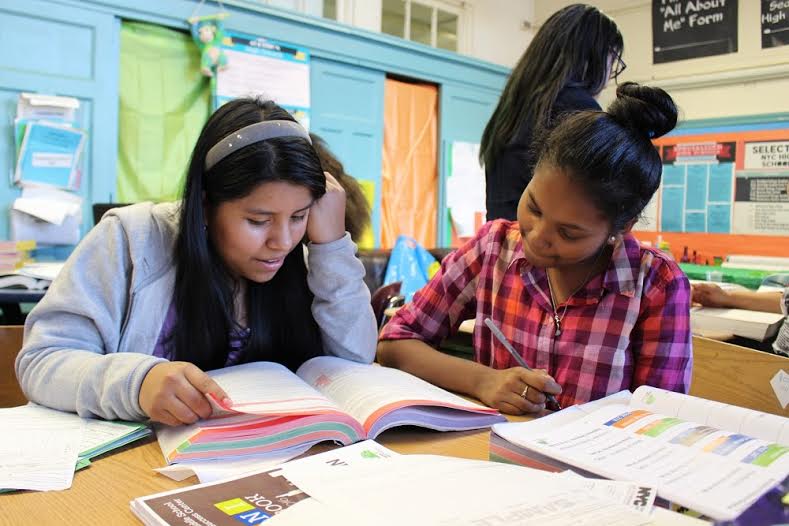
Students at Fifth Avenue Committee’s Stronger Together partnership in Brooklyn take classes for their high school equivalency diploma. Photo courtesy of Photo courtesy of Change Capital Fund
One out of five New Yorkers live in poverty. But poverty is not randomly distributed in every neighborhood. In neighborhoods of concentrated poverty—where poverty rates are upwards of 30 percent—nonprofit service providers work in a myriad of ways to help children and families in need with education, job training and placement, and housing assistance. But, often hamstrung by chronic underfunding and a siloed approach to government contracting, these organizations are not able to realize their full promise.
In May 2014, Change Capital Fund (CCF) embarked on a four-year, $5 million project to better enable community development organizations to develop and implement high-impact interventions to address the city’s persistent poverty. Launched by some of the nation’s leading funders, CCF is comprised of 16 donors with representation from banks, foundations, community development intermediaries, and the New York City Center for Economic Opportunity.
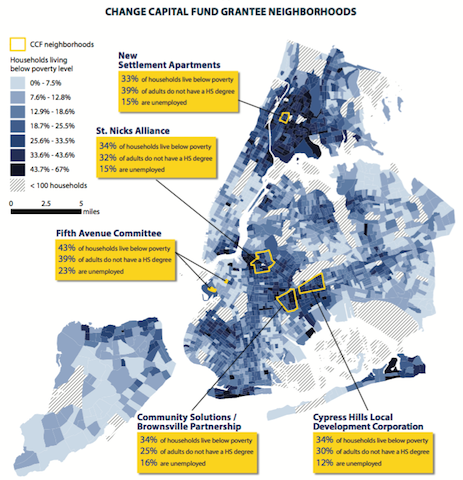
The CCF supported grantees—Cypress Hills Local Development Corporation, Fifth Avenue Committee, New Settlement Apartments, and St. Nicks Alliance—have the vision to expand their capacity and to more effectively connect low-income people to New York City’s rich economic opportunities.
Each is taking on silo-busting efforts, such as intentionally combining and coordinating services for entire households, including multiple generations—an important strategy because of the demonstrated relationship between parental and child outcomes. CCF funds also enable the grantees to assess the effectiveness of their programs by identifying and tracking outcomes that cut across their organizations’ programs.
CCF is now at the midpoint of this four-year endeavor and the grantees have made remarkable strides implementing these programs. Grantees served more than 9,000 people in the second year, a 64 percent increase over the first year. They have integrated and enhanced programs that offer educational, employment, and housing services to members of their communities; cemented partner relationships that further their reach and impact; deployed new staff members; and expanded their ability to track and use cross-program data to refine their programs.
It has never been clearer that we must find cost-effective and cross-sector solutions to reduce poverty and address inequality, and create a city where all neighborhoods are neighborhoods of opportunity.
As a result, the grantees reported significant successes in job placement, educational achievement, and housing stability:
- Grantees made 790 job placements over two years with an average wage of $11.93 in the second year, an increase of $1.21 over the first year.
- More than 1,000 students enrolled in college through a college access program, with an 81 percent persistence rate, higher than the 69 percent national average.
- The number of adults achieving training or education outcomes increased from 117 in the first year to 427 in the second year; 72 adults received their TASC (high school equivalent degrees) over two years.
- Grantees expanded their program integration, as indicated by increasing referrals, from 248 in year one to 673 in year two, and improving the rate of completed referrals from 57 percent to 69 percent.
- In addition, CCF dollars have helped grantees raise an additional $9.8 million for their neighborhoods over the first two years.
In the next year, CCF grantees, city partners, and donors will continue to build on and refine our collective efforts. We have to. It has never been clearer that we must find cost-effective and cross-sector solutions to reduce poverty and address inequality, and create a city where all neighborhoods are neighborhoods of opportunity.
View the article here: http://www.therenewalproject.com/how-a-5-million-plan-to-tackle-new-york-citys-most-persistent-poverty-is-paying-off/
]]>Cypress Hills Local Development Corporation is putting young men and women into those driver seats through the new CHAMPION Network Program.
The program offers young unemployed adults a career in the para-transportation sector – one of the city’s fastest growing sectors.
The program is funded through a grant from Change Capital Fund – a collaboration of 15 foundations and financial institutions looking for new ways to move people up the economic ladder.
For more information on the CHAMPION Network, visit www.CypressHills.org<http://www.CypressHills.org>.
Listen to the interview here (dated September 16, 2016): http://newyork.cbslocal.com/audio/the-bottom-line-for-small-business/
]]>By Alex Daniels
Residents of Cypress Hills have looked to Michelle Neugebauer for help for decades. Since she joined the Cypress Hills Local Development Corporation as its first full-time employee in 1984, she’s helped residents of the low-income Brooklyn neighborhood stave off eviction, look for jobs or internships, or get English lessons.
Ms. Neugebauer, now the community-development group’s executive director, knows the neighborhood inside out. But a grant from a consortium of 16 New York foundations, corporations, and nonprofits gave her access to data that allowed her to see Cypress Hills with fresh eyes.
“We can now look at the impact we actually have on people in the neighborhood as opposed to just what we want to achieve,” she says. “There’s a big difference.”
Her group is one of four New York nonprofits to receive support from the Change Capital Fund, an effort that began two years ago to help groups working in some of the city’s poorest neighborhoods track residents’ needs with up-to-date information. Cypress Hills, the Fifth Avenue Committee, and St. Nick’s Alliance in Brooklyn and New Settlement Apartments in the Bronx will each receive $1 million over four years to update and integrate their data-collection systems and test new ways to reach people in their communities.
On top of those grants, the consortium provided $400,000 to MDRC, a social-policy-research organization, to help the four groups marshal the collected data, measure progress, and produce studies that other neighborhood groups can use in directing their own work.
A fifth nonprofit, the Brooklyn-based Brownsville Partnership, receives support from Change Capital but dropped out of the cohort being studied by MDRC. Rather than providing direct services to residents that can be measured and analyzed by the research organization, the Brownsville group focuses on working with other nonprofits to create new job-placement systems. It’s a gradual process that’s hard to measure, according to Rosanne Haggerty, the organization’s president.
The premise behind Change Capital is that different approaches will work better in different neighborhoods. The key to success, the thinking goes, is that using data across many areas of a nonprofit can help them simultaneously get a grasp on a variety of challenges.
“Issues in urban neighborhoods are never isolated,” says Maria Martinez-Cosio, a sociologist at the University of Texas at Arlington and co-author of Catalysts for Change: 21st-Century Philanthropy and Community Development. “There’s always a connection to something else.”
‘The Environment Had Changed’
Change Capital grew out of an earlier investment pool called the Neighborhood Opportunties Fund run by many of the same donors, among them major banks like Citi, M&T, and Deutsche Bank and the Altman, Scherman, and New York foundations. Over two decades, that fund spent $25 million to rehabilitate abandoned housing and make commercial districts in poor areas of New York more inviting to businesses.
But as a hot housing market transformed neighborhoods across the city over the past decade, the grant makers saw that many residents were getting left behind, stuck in poverty. They concluded that making antipoverty programs more effective would be a better use of their money than supporting development projects, according to Kevin Ryan, a program director at the New York Foundation.
“We decided to take a step back,” he says. “The city environment had changed over time.”
The result is an approach that attempts to coordinate various social services under the roof of one neighborhood nonprofit, so that children, parents and grandparents can seek help from a single source.
Even among nonprofit staffs dedicated to helping people with low incomes, unifying those efforts can be “scary,” according to one worker quoted in a May progress report by MDRC. It is difficult, for example, to tell an education staffer that the ultimate goal of a project is to improve employment.
“Every program and division has their lens,” the employee said. “You’re saying all the work that I do is to another end. … There’s no way to make these conversations easy.”
The Change Capital approach aims to break down those barriers so grantees can share data internally and better determine where and how to direct their attention.
Community-development workers are great at carrying out their own work assignments, like job-placement help or tutoring, and measuring results, says Brandee McHale, president of the Citi Foundation. But too often, she says, they are reluctant to share information with co-workers in other program areas, making them blind to other challenges residents face.
“We’ve got to look at their [residents’] needs from a myriad of perspectives, rather than delivering services in a fragmented way,” Ms. McHale says. “Rather than thinking of their data as proprietary, they’re looking at it as a way to … make the case for how working together can produce stronger outcomes.”
Data-Driven Social Work
Each grantee spends the Change Capital money differently. St. Nick’s, which received other funding to upgrade its data collection, used the grant to hire “transformational coaches” to work with families on a broad range of issues identified by virtue of the new data capacity. New Settlement Apartments is aiming to unite 12 different departments by developing a single mission statement. The group also overhauled its website to communicate how the different programs can work toward a common goal and reworked its orientation process for recent hires so newbies can understand the broader goals of the organization.
At Cypress Hills, Ms. Neugebauer used the grant to hire the group’s first director of evaluation and research, Basil Reyes. One of Mr. Reyes’s first jobs was to work with the nonprofit’s technology staff to integrate 14 separate databases used to track social indicators in the neighborhood. He also helped design ways to use data to clue in workers across the nonprofit’s programs about where they might be needed.
For instance, parents who pick their children up at afterschool programs are asked to fill out short forms about their living situation. Ms. Neugebauer says the responses showed that nearly 20 families were behind on their rent or facing eviction. Once fed into the nonprofit’s databases, information from the education program gave the executive director and her staff a better sense of where to deploy social workers focused on employment and housing.
“Do we have the right saturation? Are we targeting the geographic area enough? We use data to inform those conversations,” Ms. Neugebauer says. Cypress Hills used to pick up on individual residents’ needs through referrals, or from personal visits to one of the group’s storefront offices. Now, Ms. Neugebauer and Mr. Reyes sort through data and “ping” social workers in the neighborhood to tell them who to visit. The result is a rapid-response system that anticipates residents’ needs.
Over the first year of the program, the nonprofit used the data to direct help to families with housing troubles. It convinced 19 employers to hire local residents. And it conducted in-depth tests on the social and emotional competencies of students enrolled in the organization’s pre-college program.
“People have to take enormous amounts of time and be really savvy to navigate these bureaucratic systems,” Ms. Neugebauer says. “As a community-based organization, we don’t want to feed into that. We want to create more access and be as easy as we can be.”
View the article here: https://www.philanthropy.com/article/1-Million-Grants-Help/237184
]]>BY OSCAR PERRY ABELLO | JUNE 2, 2016
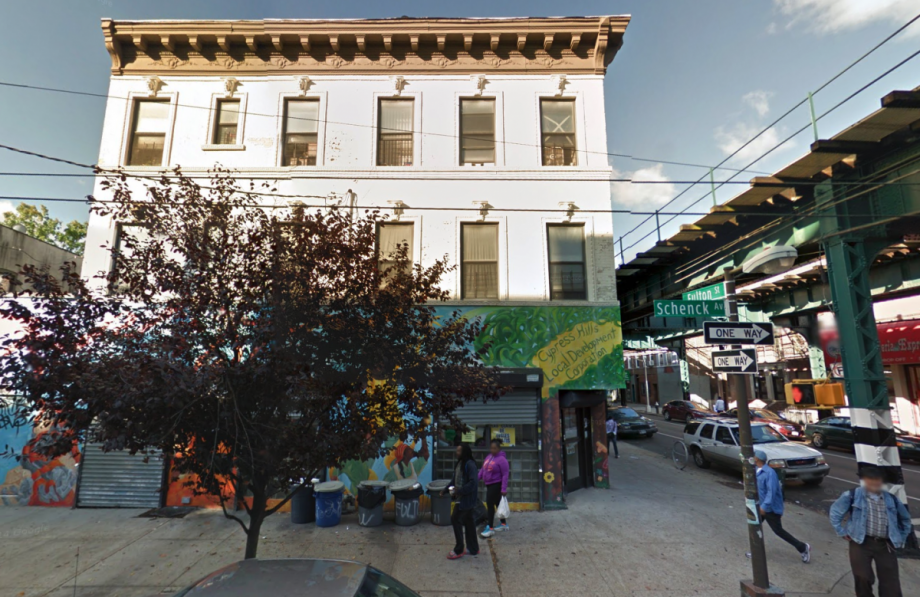
When Michelle Neugebauer came onboard in 1983 as the first full-time employee at the Cypress Hills Local Development Corporation (CHLDC), it was an entirely different time in Brooklyn.
Residents — mostly white and middle class — were fleeing the city’s rapidly integrating neighborhoods. Landlords were abandoning properties, leaving tenants to scramble for ways to maintain residency in neglected, often structurally unsound buildings.
The city was also investing taxpayer dollars in organizing tenants, homeowners and communities in some of the most neglected neighborhoods. The NYC Commission on Human Rights had something called the Neighborhood Stabilization Program (other agencies have since had different programs with the same name). By 1978, some of the numbers were already impressive. In Flatbush, Brooklyn, the program formed 57 tenant organizations just that year; in Southeast Queens, 79 block associations; in northeast Bronx, 14 tenant associations and 13 block associations.
“They would organize tenant and block groups, local development organizations and community development corporations, so that people would own and take back the neighborhood,” Neugebauer recalls. In 1983, the program formed CHLDC.
Today, as residents flock back into NYC and developers scramble for every bit of property they can get their hands on, some of those same community-based organizations, including CHLDC, now struggle for visibility and relevance.
“These groups became less sexy over the years,” says Steve Flax, who leads M&T Bank’s community reinvestment work in the NYC region. Flax is also chair of the Change Capital Fund, a consortium of 16 community development funders in the region. The consortium is now halfway through a four-year commitment of $1 million each to five community-development organizations, including CHLDC.
Consortium members, including banks, foundations, CDFIs and one city agency, have been working together as far back as 1996 for some members. Many of those directly involved with the consortium formerly worked at some of the current and former consortium grantees. In the 1990s, Flax worked at the Fifth Avenue Committee, one of the other current grantees.
 “They’re a group of true believers in community development,” Neugebauer says. Because of that, they’ve mostly stayed consistent as a group over the years, even using peer pressure among themselves to stay committed. “The consortium model allowed us to have political will internally at our own institutions to say we have to do this,” Flax says.
As a consortium, they’ve historically encouraged grantees to explore next logical steps in serving their communities.
CHLDC, for example, has already developed over 400 units of affordable housing since 1983, but never in a building of more than 27 units. With funding from the consortium, they hired a project manager to develop one project with 60 units and a supermarket on the ground floor, and another project with 54 units of senior housing. CHLDC has also worked more than 15 years revitalizing the main commercial corridor in the area, improving storefronts and getting entrepreneurs of color, almost all of them residents of the area, set up along the corridor.
Those efforts, however, “didn’t really produce a lot of jobs,” Neugebauer says. CHLDC learned from working with the Pratt Center on Community Development that manufacturing wages are better paying on average than retail job earnings. They’re now looking to acquire and develop a manufacturing space, with prospective tenants including food manufacturing companies and a rooftop urban agriculture group. Consortium funding allowed CHLDC to hire another project manager for this project. “It was a strategic decision to use our experience in developing residential space and partner with people that have done manufacturing space development and create some good living wage jobs in manufacturing in the neighborhood,” Neugebauer says.
CHLDC also has a suite of programs designed to get and keep youth on the path to college graduation. It starts in middle school, featuring peer counselors, eight graders who help other eighth graders figure out the best place to go to high school (NYC allows eight graders to choose to go to a high school outside their neighborhood, using a complicated lottery and preference system). “NYC high schools really vary in their quality, in their graduation rate, the number of young people they send to college,” Neugebauer explains. The suite also features peer counselors to help 11th and 12th graders with the college application and admissions process. CCF funding is helping them work out a program to fill in the gap at the ninth- and 10th-grade levels.
All of these projects barely even scratch the surface of CHLDC, which serves over 10,000 people a year through its holistic and comprehensive menu of programs, from workforce development to after school programs to tenant harassment enforcement and more. Neugebauer says her biggest fear is that they come off like a shadow bureaucracy. Support from the consortium also helps them tie it all together, by giving them the resources to hire their first ever director of evaluation and research.
“We want to figure out of those 10,000 people, how many families are we touching, what is the intensity of the service we’re providing to these families, and if there’s multiple interventions, whether that sum of interventions is meaning more in terms of lifting people out of poverty,” Neugebauer explains. “I’ve dedicated my whole career to this, but now I can really prove — or in some cases not prove — and be able to improve our work to have an impact on people’s lives in a really deep way.”
The stakes are higher still than just whether or not groups like CHLDC still matter and make a difference for struggling neighborhoods and households in NYC. Ultimately, the funder consortium believes it is out to prove that this kind of work is worthy of much larger-scale support from the public sector. The focus on gathering data is part of all five grantees’ work plans, in part for the purpose of proving that groups like these matter more than they’re currently valued by many other possible funding sources.
“It’s very clear, CDCs are consistently under-resourced with increasing demands put on them. Private dollars, foundation dollars will never fill the gap. It’s gotta be government,” says Flax. “We owe it to these groups and these communities to get in front of the mayor, get in front of HUD, get in front of the governor’s office and make our pitch.”
The Equity Factor is made possible with the support of the Surdna Foundation.
]]>
Read more here.
]]>